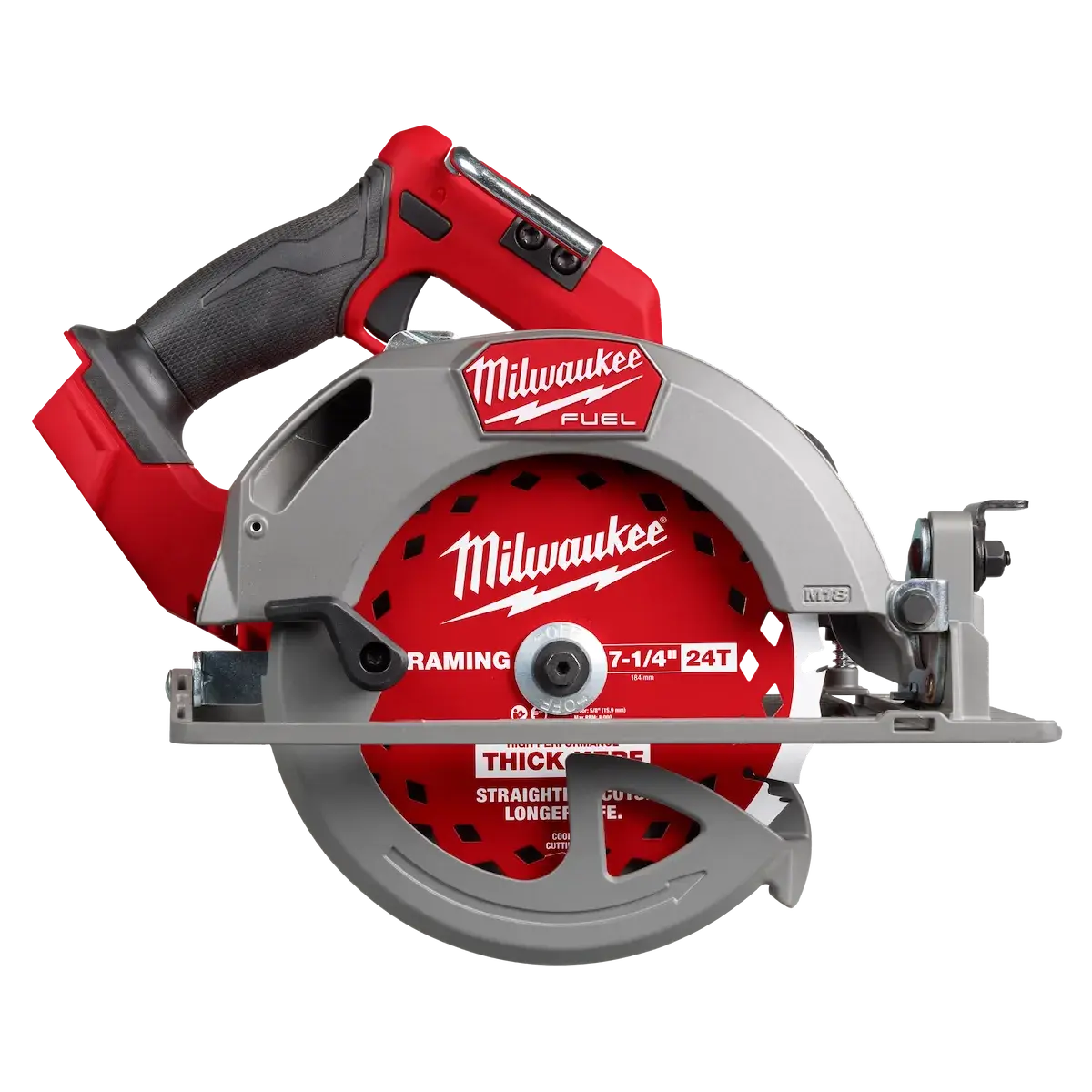
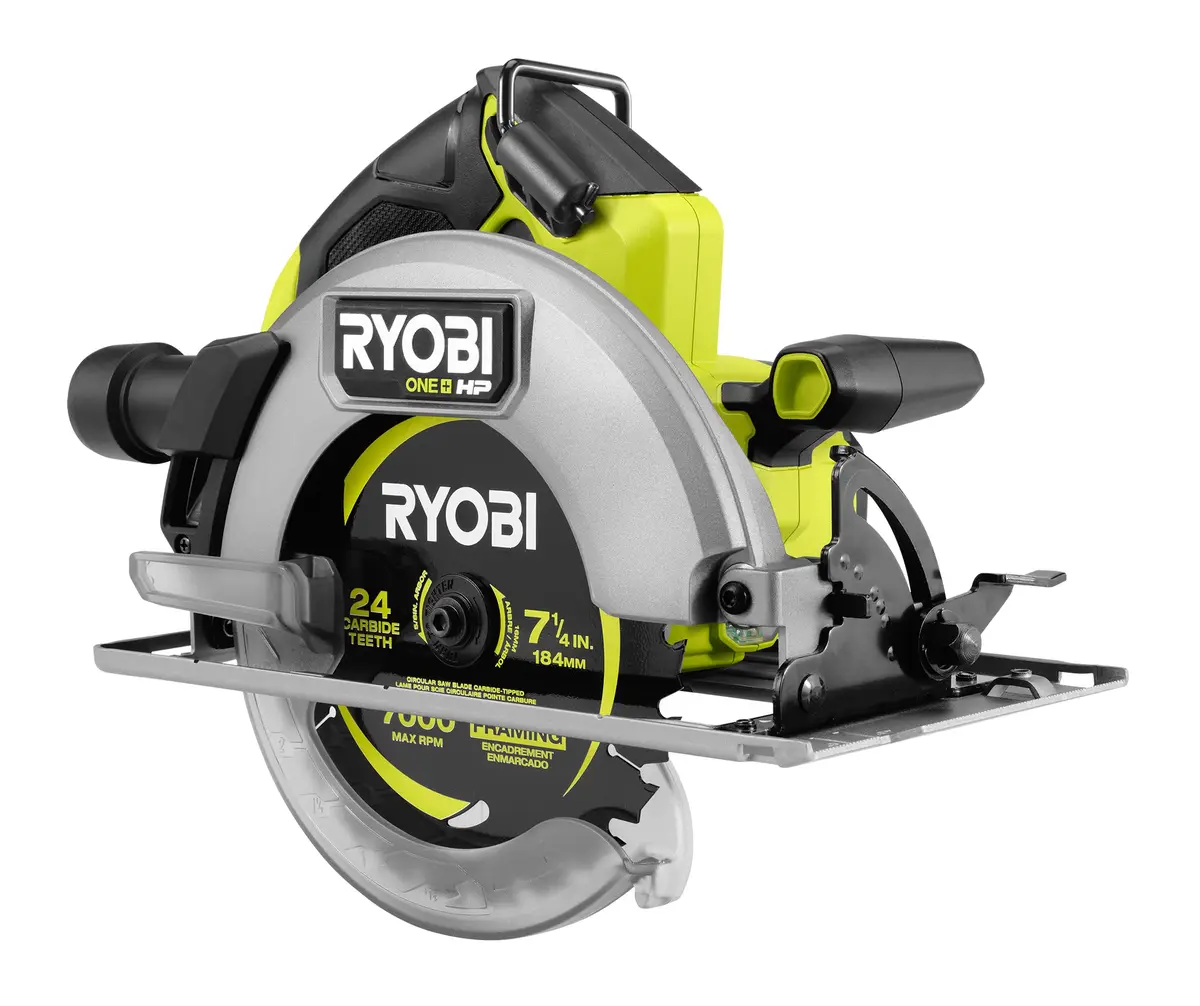
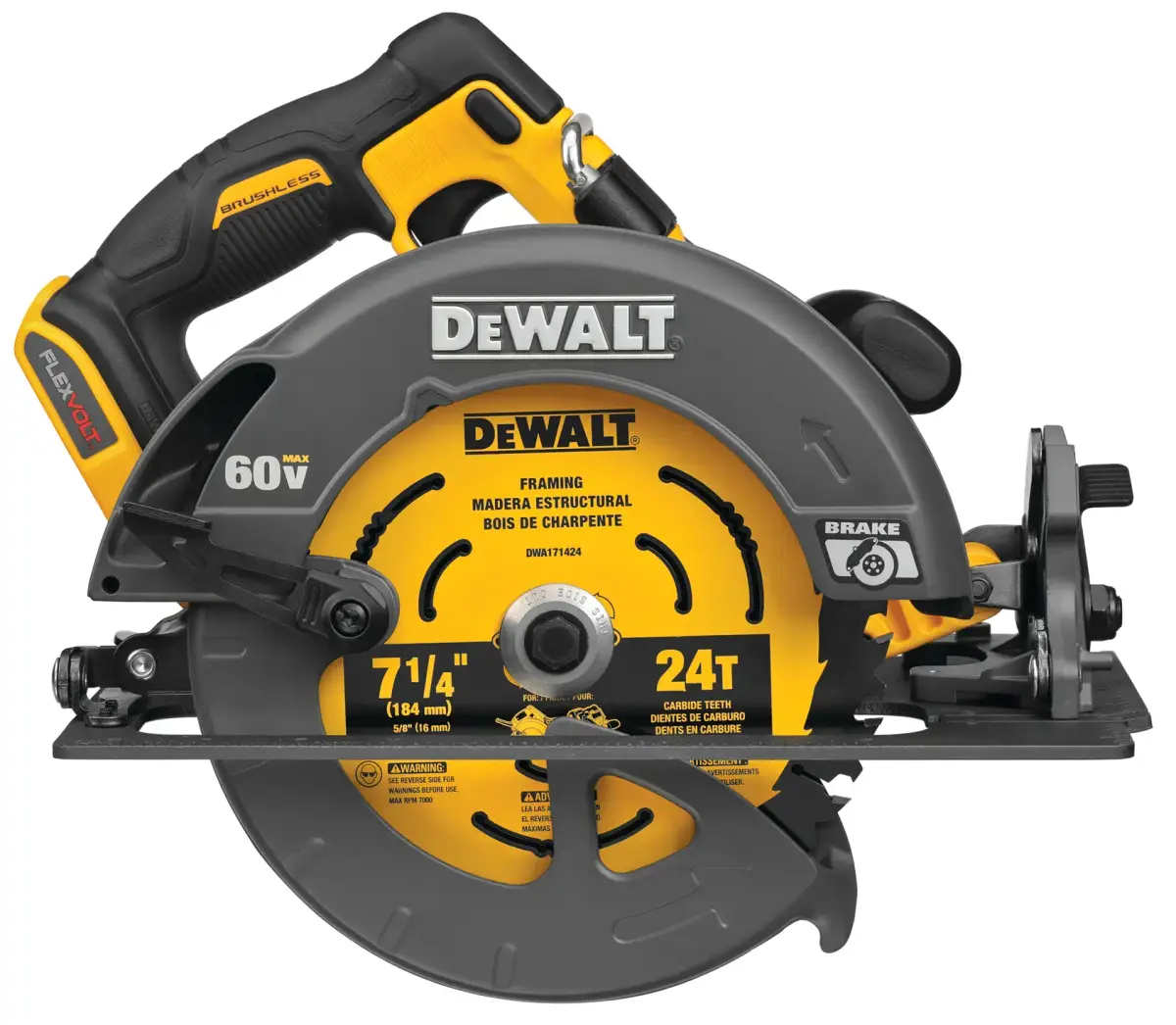
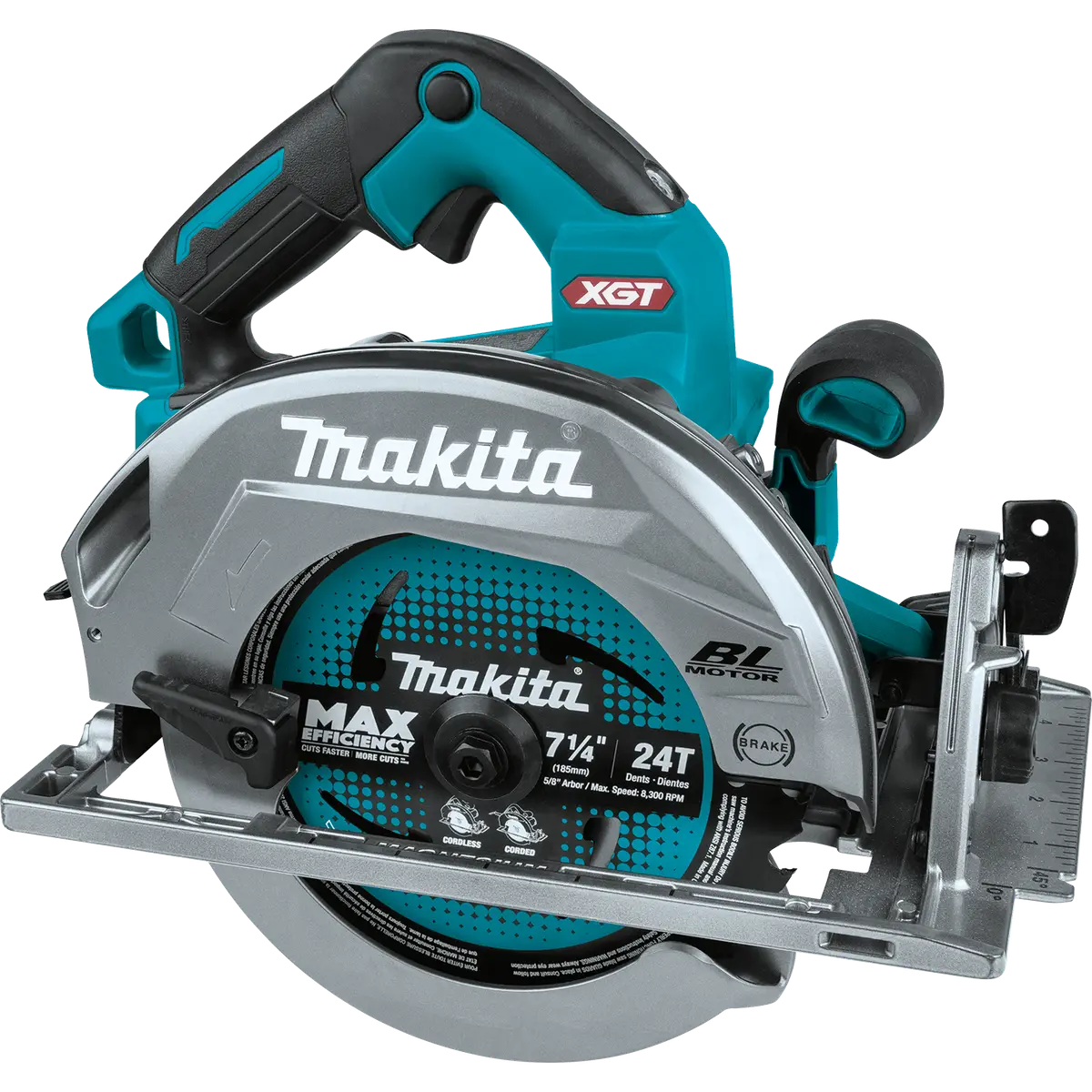
If you frame, remodel or cut sheet goods away from an outlet, the four 7-1/4 inch cordless saws most buyers shortlist are the Milwaukee M18 FUEL 2834, the Ryobi 18V ONE+ HP PBLCS302, the Makita 40V max XGT GSH01 and the DeWalt FlexVolt 60V Max DCS578. In Pro Tool Reviews’ cordless circular saw guide, they scored 95, 88, 83 and 82, in that order, out of the 12 saws the guide covers.
The guide is undated, so treat its prices as a snapshot. On November 14, Ryobi’s own site still listed the PBLCS302B bare tool at $139.00, the same figure the guide gives.
How did the four saws score?
Pro Tool Reviews fitted every saw with the same Diablo 24 tooth framing and demolition blade, so the blade does not decide the result. Each saw ran on its own brand’s battery, though, and those differ in size: 8.0Ah Forge for the Milwaukee, 8.0Ah Edge for the Ryobi, 4.0Ah High Power for the Makita and 9.0Ah FlexVolt for the DeWalt.
| Saw | Platform | Score | Bare / kit price in the guide |
|---|---|---|---|
| Milwaukee M18 FUEL 2834 | 18V | 95 | $279 / $449 |
| Ryobi PBLCS302 | 18V ONE+ HP | 88 | $139 / $199 |
| Makita GSH01 | 40V max XGT | 83 | $289 / $469 |
| DeWalt DCS578 | 60V FlexVolt | 82 | $299 / $399 to $549 |
The guide lists the prices with a dollar sign and no other currency. The kit prices show the real cost of starting on a platform: the Ryobi kit costs less than any of the other three bare tools.
Which saw cuts fastest?
The Milwaukee, according to Pro Tool Reviews. On a rip through double stacked 3/4 inch OSB it needed 9.76 seconds, against 13.53 for the Makita, 14.10 for the Ryobi and 15.53 for the DeWalt.
The full depth cut reshuffled the order:
| Pro Tool Reviews test | Milwaukee | Ryobi | Makita | DeWalt |
|---|---|---|---|---|
| Rip cut, OSB | 9.76 s (1st) | 14.10 s (6th) | 13.53 s (4th) | 15.53 s (8th) |
| Full depth cut | 17.41 s (2nd) | 17.85 s (3rd) | 24.74 s (9th) | 19.52 s (4th) |
| Weight as tested | 10.81 lb | 10.78 lb | 10.09 lb | 11.53 lb |
The Ryobi was within half a second of the Milwaukee on the full depth cut, which is where the $139 price starts to look strong. The Makita was the lightest as tested but slowest on deep cuts, partly because it ran on the smallest battery.
What else did the test score?
Beyond speed, the guide scored stake cutting, dust collection, blade guard action, sight lines and shoe friction.
| Category | Milwaukee | Ryobi | Makita | DeWalt |
|---|---|---|---|---|
| Stake cutting (of 3) | 3 | 3 | 2 | 3 |
| Dust collection (of 3) | 3 | 1 | 3 | 2 |
| Guard action (of 9) | 9 | 8 | 9 | 9 |
| Sight lines (of 6) | 6 | 5 | 4 | 5 |
| Shoe friction (of 3) | 3 | 3 | 3 | 1 |
Pro Tool Reviews noted that the Makita has no rafter hook and partly hidden sight lines, that the DeWalt’s vacuum adapter is sold separately, and that the Ryobi’s plastic lower guard points to serious DIYers rather than full time pros.
What do the maker spec sheets say?
The maker pages mostly agree with the guide. Milwaukee lists 6,000 rpm, a 2-5/8 inch cut capacity, a rafter hook, an electric brake, a magnesium shoe and an included vacuum adapter, and claims up to 750 cuts per charge on its large FORGE HD12.0 battery. Ryobi lists 2-9/16 inches at 0 degrees, 1-27/32 inches at 45 degrees, a 0 to 56 degree bevel and up to 370 cuts per charge.
Makita lists 6,000 rpm, 2-5/8 inches at 90 degrees and 1-13/16 at 45, an electric brake, 9.7 lbs with battery, a 3-year warranty and AWS wireless dust extractor pairing with a transmitter sold separately. DeWalt lists 5,800 rpm, 2-9/16 inches at 90 degrees, a 57 degree bevel and an electric brake.
The cuts per charge figures are the makers’ own claims on different batteries, and Pro Tool Reviews did not measure runtime, so they cannot be compared directly.
Which battery do you need?
This matters more than the score for most buyers. The Milwaukee and Ryobi run on 18V packs, the Makita on 40V max XGT packs, and DeWalt’s page says the DCS578 runs on FLEXVOLT 20V/60V MAX batteries, sold separately. Standard 20V MAX packs are not listed as compatible on that page, so DeWalt 20V owners may need a FLEXVOLT pack.
Warranties also differ: 5 years for the Milwaukee per the guide and Milwaukee’s page, 3 years for the other three.
Are there other saws worth a look?
The Metabo HPT C3607DB scored 81 in the same guide, tied the Milwaukee for the fastest rip at 10.10 seconds and has a lifetime warranty, but dust collection was not tested. The Hilti SC 30WR-22 scored 76 with a 20-year warranty at $419 bare. Pro Tool Reviews also lists a ONE-KEY version of the Milwaukee, the 2835, which adds tool tracking and wireless vacuum activation.
Who it suits
- Professional framer or remodeler on M18: the Milwaukee had the best score, the fastest rip and a 5-year warranty. Price the battery too, since the test used an 8.0Ah Forge pack and the cuts per charge claim uses a 12.0Ah pack.
- Serious DIYer or homeowner on a budget: the Ryobi scored 88 at $139 bare and $199 as a kit, and nearly matched the Milwaukee on deep cuts. Expect more dust and check the plastic lower guard suits how hard you work it.
- Crews already on Makita XGT: the GSH01 scored full marks for dust and guard action and pairs with AWS extractors. It was slowest on full depth cuts and has no rafter hook, so heavy framing is its weak spot.
- DeWalt FlexVolt owners: the DCS578 has a 57 degree bevel and strong power, but it was the heaviest as tested and scored 1 of 3 on shoe friction. It makes sense mainly if FLEXVOLT packs are already in your truck.
- First time buyer: pick the battery platform first. The best saw for you is usually the one that shares batteries with the drill you already own or plan to buy.
Read Pro Tool Reviews’ full guide for the test method, then check the current bare tool and kit prices for your platform at your local store before you buy.