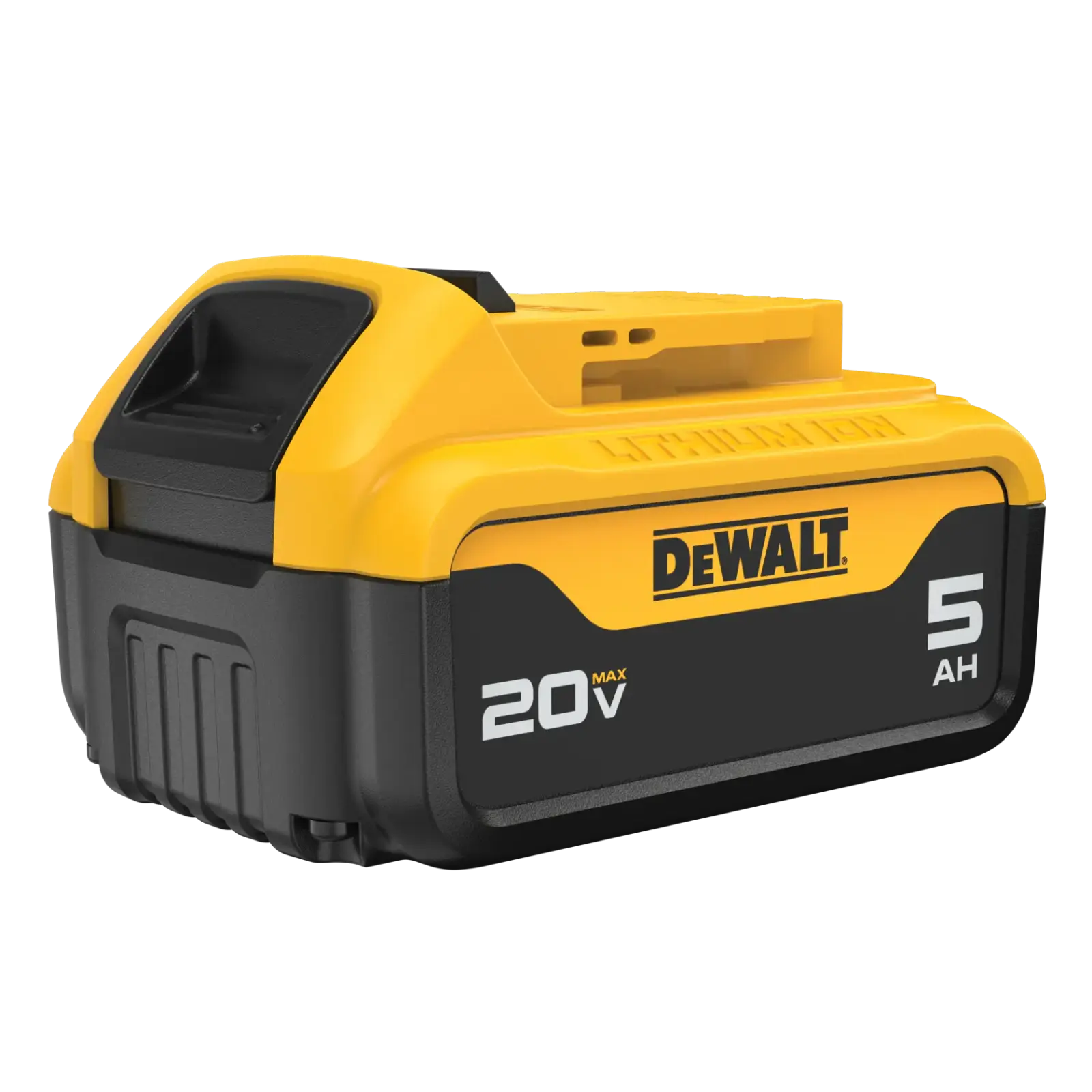
Battery labels on cordless tools lead with one number, the amp hours, and shoppers often read it as a plain measure of size. The sources agree it is more subtle. Amp hours describe stored charge, runtime also depends on voltage and the load, and a larger pack can change how a tool behaves under heavy work. This guide combines two ToolGuyd explainers, a published drill comparison from Pro Tool Reviews and the maker’s own DEWALT product page for the 20V MAX 5Ah battery, model DCB205.
What the amp hour number means
ToolGuyd defines an amp hour (Ah) as a measure of charge capacity. In ideal conditions a 1.0Ah pack could supply 1.0A for one hour, so a tool drawing 1.0A would drain it in about that time. ToolGuyd adds that a 4.0Ah pack can give more than double the runtime of a 2.0Ah pack, but that depends on how the packs are designed. It also says a bigger pack can offer more power headroom, yet you typically will not see double the power.
Why watt hours compare better
ToolGuyd argues that amp hours alone mislead when voltage systems differ, because energy in watt hours (Wh) is volts multiplied by amp hours. Its examples:
- An 18V 4Ah pack is 72 Wh, and an 18V 5Ah pack is 90 Wh, which is 25% more.
- A 24V Max 4Ah pack is 96 Wh, and a 40V Max 2.5Ah pack is 100 Wh.
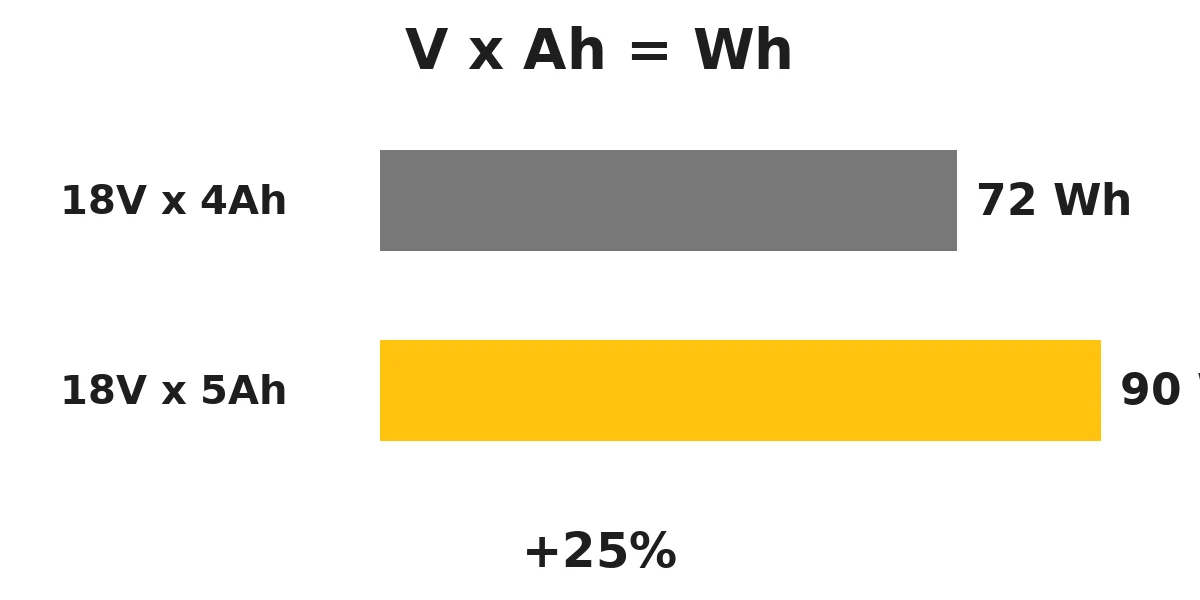
Energy in watt hours is volts multiplied by amp hours, so a 5Ah pack holds 25% more energy than a 4Ah pack at the same voltage.
The voltage label needs care. DEWALT states on its DCB205 page that the 20V MAX figure is the maximum initial voltage unloaded, and that the nominal voltage is 18 volts. ToolGuyd puts an 18V 5Ah pack near 90 Wh and the same capacity on a 20V Max label near 100 Wh when the maximum voltage is used, and its commenters note that brands do not all quote Wh on the same basis. When you compare, use one basis for every pack.
What a published drill comparison found
Pro Tool Reviews compared a Makita 18V LXT 2.0Ah pack with a 5.0Ah pack on one Makita drill driver, timing holes through stacked OSB and untreated 2x4 lumber. The 5.0Ah pack was faster in every test it reported:
- 1 inch auger bit: 4.33 seconds against 4.48 seconds
- 1 inch spade bit: 3.59 seconds against 4.00 seconds
- 1 1/2 inch self feed bit: 10.28 seconds against 12.08 seconds
- 2 9/16 inch self feed bit: 11.26 seconds against 14.60 seconds
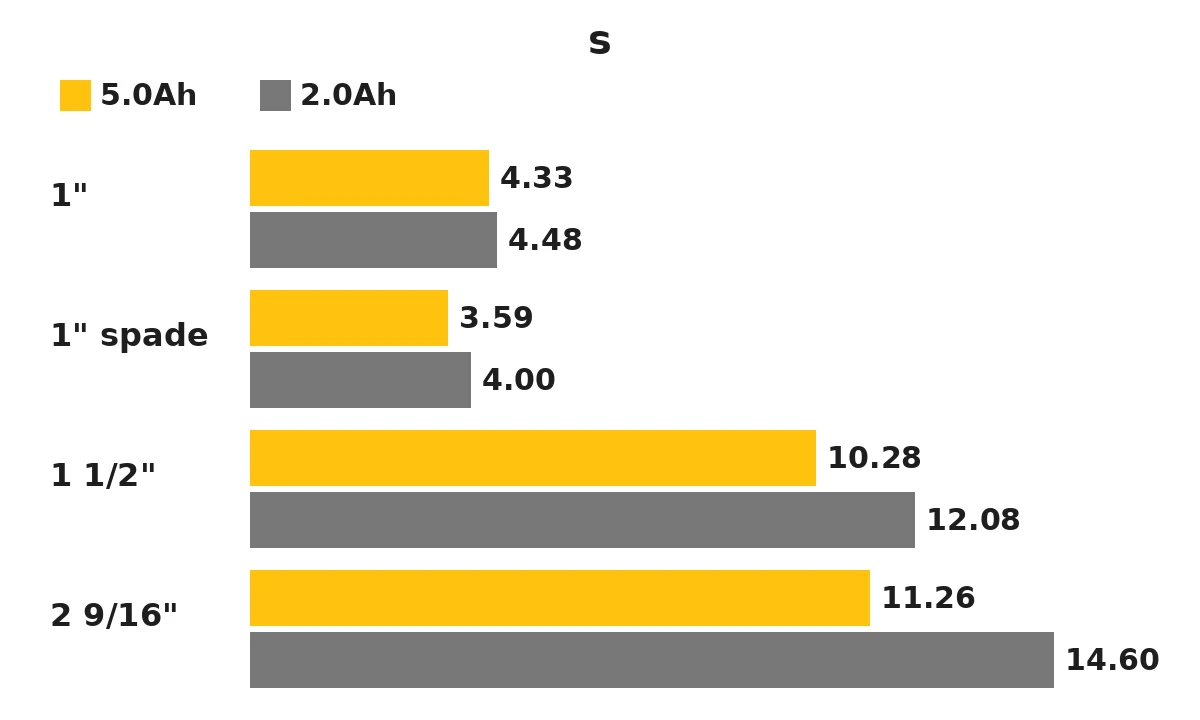
Pro Tool Reviews timings in seconds for the 5.0Ah pack and the 2.0Ah pack. The gap grows as the bit demands more power.
Pro Tool Reviews concluded that amp hours do affect power and that the gap grows with the demand of the job. It explained that the 2.0Ah pack has five cells and the 5.0Ah pack ten, so the load is shared across more cells. It suggested the smaller pack for light work to save weight and the larger one for medium and heavy work. This was one tool and one pair of packs, so treat it as one data point. Torque Digest did not test these packs.
Who it suits
- Professional tradesperson: A higher Ah pack gives longer runtime and, per Pro Tool Reviews, quicker work on demanding bits. Check the weight in your hand and carry spares so charging does not stall the day.
- Serious DIYer: One 5Ah pack covers most weekend jobs. Check the voltage label basis if you mix brands.
- First time buyer: Look at the kit’s pack size, since a bare tool has none. Pro Tool Reviews suggests a smaller pack is fine for light work.
- Homeowner on a budget: A smaller pack costs less and weighs less. Check that it matches the tools you already own.
- Someone already on a platform: Stay with the same system. Compare packs inside it by Ah, and across systems by Wh.
- Crew buyer: Standardise on one voltage system, compare by Wh, and check how each maker states its voltage before you order in bulk.